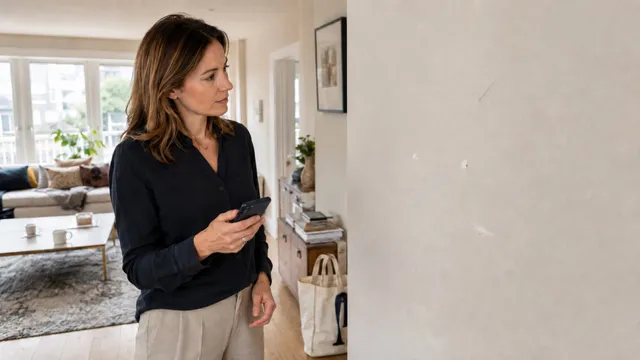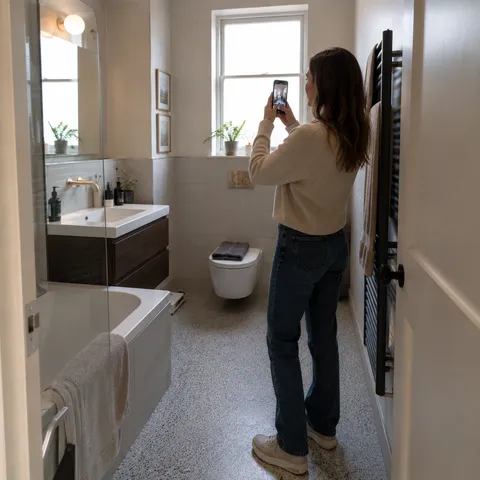
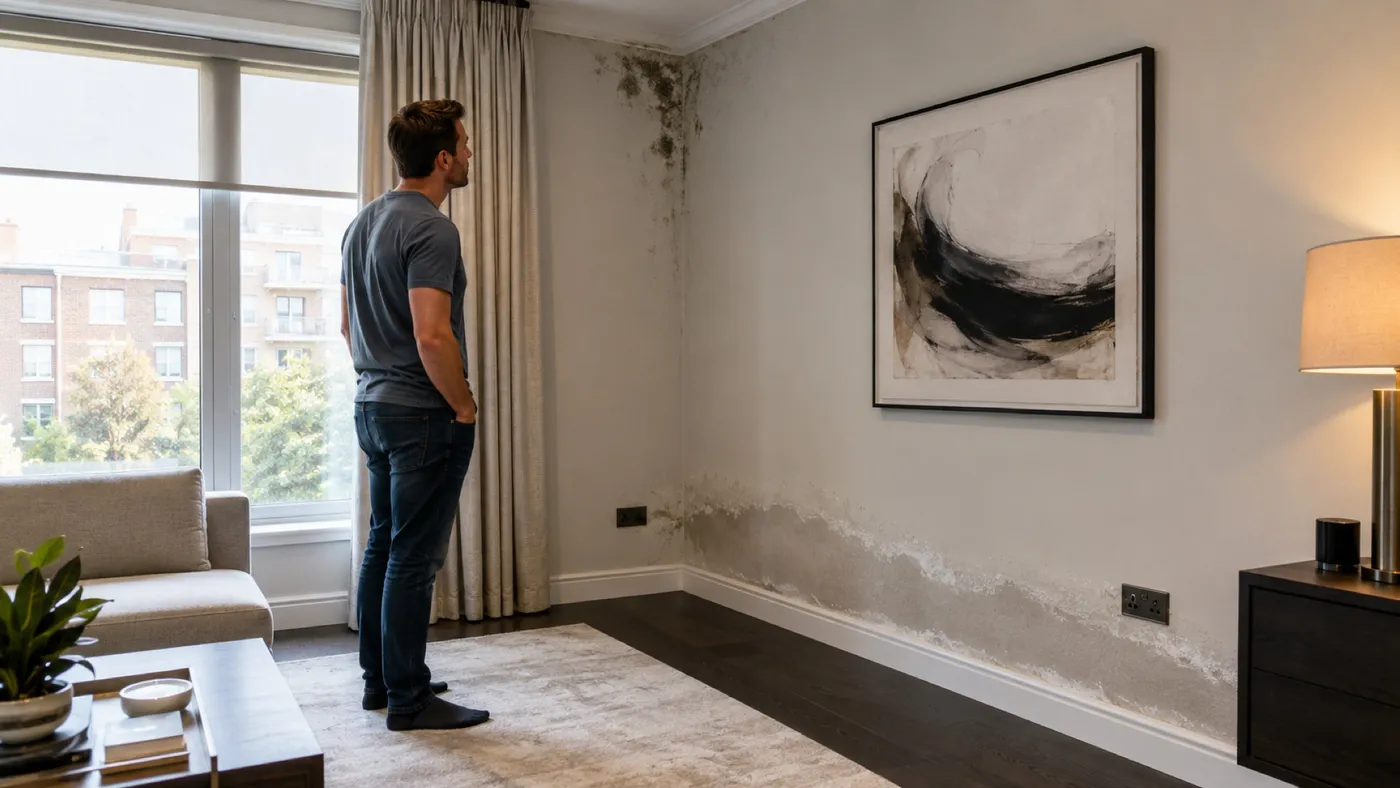
Record what you see, not what caused it. Note the location, extent, colour and the surface affected, then photograph it with a context shot and a close-up. Use plain observational wording such as “black spotting to lower external wall behind wardrobe”. Do not name the cause, and do not imply tenant lifestyle or landlord defect. Your job is to describe, not diagnose.
This applies UK-wide. The principle is the same in England, Wales, Scotland and Northern Ireland: an inventory or inspection report is a record of observed condition, not a technical survey and not a verdict on fault. Cause of mould is often contested and rarely provable from a visual inspection. So you describe the signs and leave the mechanism to whoever
assesses it later.
The reason this matters is evidential. Your words can end up in front of a deposit adjudicator, an environmental health officer, or a court. A neutral, factual entry is useful to everyone. A causal claim you cannot prove is a liability for you and can mislead both parties.
What is the difference between condensation mould, penetrating damp and rising damp?
This section is background understanding for you, not a set of labels to put in the report. Knowing how the three tend to present helps you describe the signs accurately. It does not mean you should name which one you think you are looking at. You do not need to decide that. You do need to describe the signs accurately enough that someone who can decide has the information.
The short version: condensation mould grows on cold surfaces from moisture in the air, penetrating damp comes through the building fabric from outside, and rising damp travels up from the ground. Here is how the three tend to present, and the kind of wording that stays neutral.
Feature
Condensation mould
Penetrating damp
Rising damp
Typical location
Cold spots: window reveals, external corners, behind wardrobes on external walls, cold ceilings
Localised patch, often mid-wall, near a suspected external source (gutter, roof, wall)
Low down, base of walls, usually within about a metre of floor level
Visual signs
Black speckled spotting, sometimes green, on the surface; often clusters at cold points
Brown or yellow-edged staining, sometimes flaking; may feel damp; patch shape often irregular
Horizontal tide-like mark low on the wall, possible salt deposits, blown or crumbling plaster near skirting
What to photograph
Context shot showing the cold feature (single-glazed window, external corner), then close-up with a scale reference
Wide shot showing the patch position on the wall, then close-up of the staining edge
Wide shot showing height above floor, then close-up of the tide mark and skirting
Neutral wording to use
“Black mould spotting to window reveals, kitchen” or “black mould build up to lower external wall behind wardrobe”
“Brown mould staining across to mid-wall”
“Tide-like brown staining to base of wall, approx 40cm high, and blown plaster at skirting”
Notice what the wording column does not do. It does not say condensation, penetrating or rising. It does not say the tenant failed to ventilate or the landlord failed to repair. It describes what is on the wall. The first three columns are there to sharpen your eye. The last column is the only one that belongs in the report.
What should I actually write in the report?
Write location, extent, colour and affected surface, in plain observational language. That is the whole method.
A good entry has 3 parts:
- Location. The room, and where in the room. “Behind the wardrobe at mid level on the right hand side. Photograph against something of known size if you can.
- Colour and character. “Black spotting”, “brown staining”, “green surface growth”. Colour and pattern are facts you can see.
- **Surface affected. **“Painted plaster”, “window sealant”, “grout to shower enclosure”, “cold external corner”.
So the entry reads: “Black spotting, approx 30cm x 20cm, to painted plaster on external corner above window reveal” That sentence survives scrutiny. It tells a later reader exactly what you saw and where, without you having guessed why.
Avoid words that carry a verdict. “Condensation mould” names a cause. “Tenant-caused” and “neglected” assign fault. “Damp problem” implies a defect. Strip all of it out.
Should I record ventilation and building features too?
Yes, but as observed facts, not as evidence for a conclusion. Note what is present. Do not note what it proves.
Write “extractor fan present to bathroom ceiling, not tested for function unless within scope” or “trickle vents present to window frames, closed at inspection” or “single-glazed sash window to bay.” These are neutral observations. They will be useful to whoever assesses cause later, because ventilation and cold surfaces are relevant to that assessment. But you are not the one drawing the line between them and the mould.
The trap is writing “trickle vents closed, hence condensation”. That is a causal claim, and it is exactly the kind of wording that comes back on you. Record the vent state. Stop there.
How should I photograph mould and condensation?
Take two shots minimum: a context shot showing where the affected area sits in the room, then a close-up with a scale reference. The context shot proves location. The close-up proves character and extent.
For the context shot, capture the cold-spot relationship if there is one. If the spotting is beside a single-glazed window or on an external corner, get that in frame. You are recording the physical relationship as a fact, not interpreting it. For the close-up, a coin, a tape measure or a sticky note of known size gives scale that survives compression when the image is emailed around.
Date-stamp through your report metadata or camera settings, and keep the originals. A blurry mobile photo with no context is weak evidence. A clear pair of shots, wide then close, is strong.
Where does this sit against damp and mould guidance?
Government guidance treats damp and mould as a housing hazard to be assessed by a qualified assessor, not something a condition report should adjudicate. Your report is not itself a hazard assessment, and nothing in this method turns it into one. The Housing Health and Safety Rating System (HHSRS) guidance on GOV.UK is the framework under which damp and mould growth is assessed as a hazard. That assessment, and any decision on who must remediate, is a separate exercise from your inspection.
The GOV.UK publication Understanding and addressing the health risks of damp and mould in the home treats cause and responsibility for damp and mould as matters requiring proper investigation. That reinforces the point of this whole method: your report flags presence and extent so a competent person can take it forward. It does not settle the question.
A note on limits, and please read it as central rather than as a footnote. This is general guidance for recording condition. It is not legal advice, and it places no legal duty on you as a clerk. Recording what you see does not make you responsible for cause, remediation or compliance. Who must fix damp and mould, and how quickly, is a liability question that turns on the tenancy, the property and the relevant law of the nation you are in. The mention of adjudicators, environmental health and courts above describes only where your words may later be read, not any obligation on you. If a report is heading towards a dispute or an environmental health referral, the parties should take their own advice.
A short recap
Describe, do not diagnose. Location, extent, colour, surface. Photograph wide then close, with scale. Record ventilation and cold features as plain facts, never as proof of anything. Keep the word “condensation” and any hint of blame out of the description entirely. Do that consistently and your report helps everyone and exposes no one, including you.
Sources:
Housing Health and Safety Rating System (HHSRS) guidance, GOV.UK
Understanding and addressing the health risks of damp and mould in the home, GOV.UK