It depends on the cause. If the mould comes from a property defect, a leaking roof, no extractor fan, poor insulation, or a failed damp-proof course, it is the landlord’s responsibility to fix. If it comes purely from how the home is used, windows kept shut, no ventilation despite it being available, drying laundry indoors with no airflow, and there is no underlying defect, it sits with the tenant to manage. The landlord must investigate before reaching that conclusion. They cannot simply decide it is “lifestyle” and walk away.
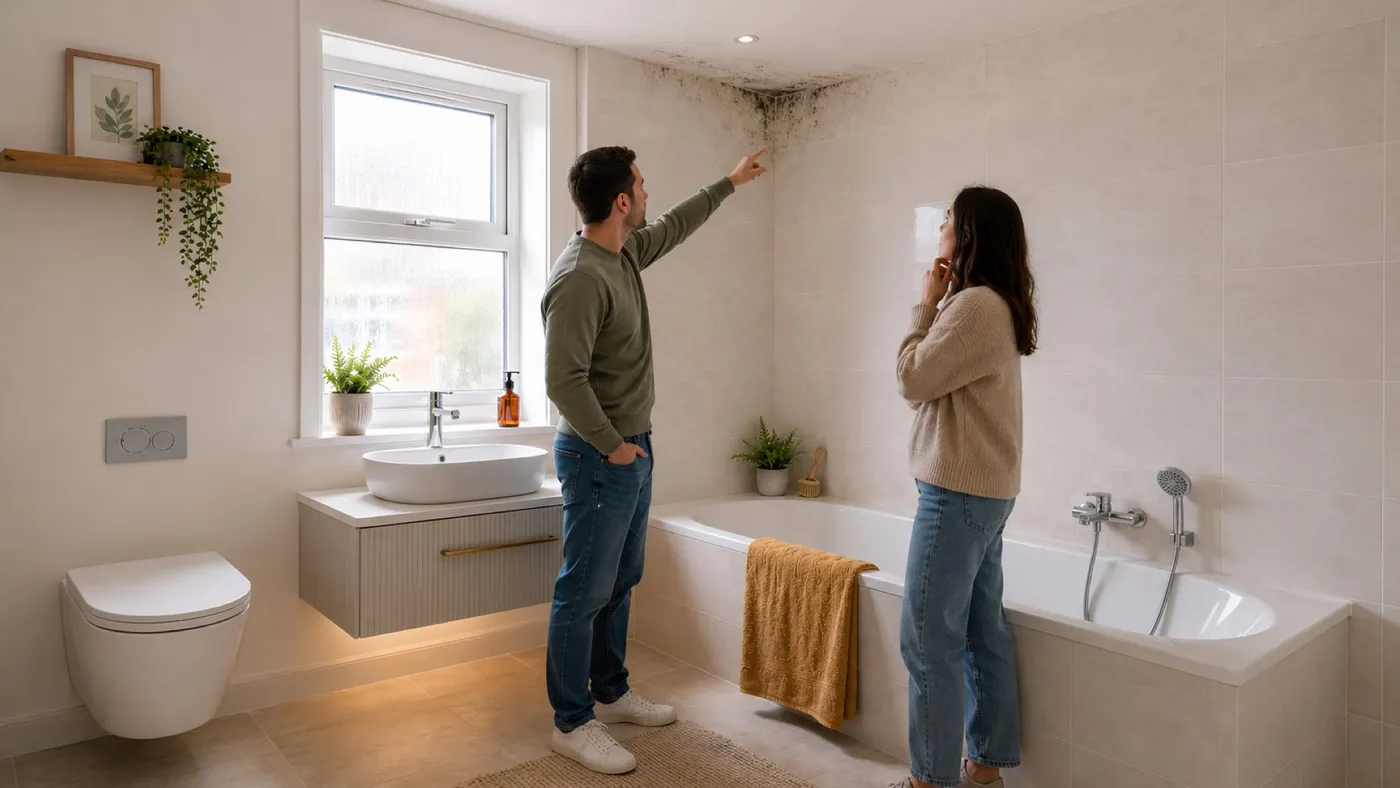
Picture the scene. A tenant in a second-floor flat notices black spotting creeping across the bathroom ceiling. They message the landlord. The landlord replies that the previous tenant never had this problem, and asks whether they’re using the extractor fan. The tenant checks. There isn’t one. Now what?
That single missing fan changes the entire legal picture. Liability in mould disputes almost always turns on one practical question: did the property give the tenant a reasonable way to prevent it. Get that question answered properly, and most of what follows is straightforward.
How do you tell whether mould is the landlord’s responsibility or the tenant’s?
Ask whether the property gave the tenant a reasonable way to avoid it. If there was no extractor fan in a windowless bathroom, no trickle vents, single glazing with nowhere for moisture to escape, or a structural defect like a leaking gutter or absent damp-proof course, responsibility sits with the landlord, because no amount of tenant behaviour fixes a missing fan. If the property had adequate ventilation and heating available and the tenant simply didn’t use it, blocked vents with furniture, or dried laundry indoors with windows shut for months, the cause is more likely the tenant’s, but the landlord still has to check this rather than assume it.
What legal duties does a landlord have for damp and mould?
Three pieces of legislation sit underneath this, separate from anything BTR-specific. Section 11 of the Landlord and Tenant Act 1985 requires the landlord to keep the structure, exterior, and key installations, heating, water, sanitation, gas, electricity, in repair. The Homes (Fitness for Human Habitation) Act 2018 implies into most tenancies a duty that the home is fit to live in at the start of the tenancy and throughout it, and severe, unaddressed damp or mould can make a home unfit under that test. Separately, local authorities can assess damp and mould as a hazard under the Housing Health and Safety Rating System (HHSRS), created by the Housing Act 2004, and can issue improvement notices where it’s serious enough.
What is Awaab’s Law, and does it apply to private tenants yet?
Not yet, as of July 2026. Awaab’s Law currently applies to most social housing tenancies in England. It came into force for the social rented sector on 27 October 2025, setting fixed deadlines: investigate within 10 working days, provide a written summary within 3 working days of finishing that investigation, carry out safety works within 5 working days where a significant hazard is confirmed, and act within 24 hours for anything posing an immediate risk to health.
For private rented homes in England, Awaab’s Law has not yet been brought into force. The Renters’ Rights Act 2025 gives the government the power to extend Awaab’s Law to the private rented sector, but the detail still needs to be set through further regulations. The government’s current implementation roadmap lists the private rented sector extension as TBC and subject to consultation. Until those regulations are made, private landlords remain under the existing duties to act within a reasonable time, depending on the seriousness of the issue.
What is a tenant expected to do to prevent mould?
Use whatever ventilation and heating the property actually provides, open windows, run extractor fans, avoid pushing furniture flush against external walls, and act in what the law calls a “tenant-like manner”: handling small day-to-day upkeep, and reporting problems promptly rather than letting them sit. None of this shifts responsibility for a genuine structural or ventilation defect onto the tenant. It only matters where the property gave them a working way to prevent the problem and they didn’t use it.
How do you weigh up landlord vs tenant responsibility in practice?
Use the table as a starting point for investigation, not as a final liability decision. Damp and mould can have more than one cause, so the key question is still what the evidence shows about the property, the ventilation, the heating, any defects, and how the home was being used.
Damp or condensation scenario
Typical responsibility
Landlord’s duty
Tenant’s duty
Evidence that helps either side
Condensation from poor ventilation or insulation
Landlord
Investigate the cause, then fit or repair ventilation or insulation where needed
Report promptly and allow access for repairs
Dated photos of fan or vent condition
Penetrating damp from a structural defect
Landlord
Repair the structure or exterior under Section 11
Report promptly
Photos of the external defect and weather pattern
Rising damp from a failed damp proof course
Landlord
Install or repair the damp proof course
Report promptly
Tide mark height and salt deposits
Condensation despite adequate ventilation being provided
Tenant, once investigated
Investigate first and avoid assuming lifestyle causes without checking
Ventilate, heat reasonably and avoid blocking vents
Photos showing shut windows or blocked vents, alongside proof that ventilation was present and working
What should a tenant do if they report mould and nothing happens?
Put it in writing if it was only said verbally, so there’s a dated record. If nothing changes, contact the local authority’s environmental health team, who can assess the property under HHSRS and issue an improvement notice where the hazard is serious enough. A tenant can also bring a disrepair claim through the county court for breach of section 11 or the Fitness for Human Habitation Act, seeking both repairs and compensation. Since Section 21 has been abolished for new private rented possession notices from 1 May 2026, and most assured shorthold tenancies automatically became assured periodic tenancies on that date, the old fear of a new retaliatory “no-fault” eviction for raising a complaint no longer applies in the same way. There may still be transitional cases where a valid Section 21 notice was served before 1 May 2026.
Where does this sit against the law and official guidance?
This is England-specific. Scotland has its own Repairing Standard and a separate set of damp and mould regulations coming into force in October 2026; Wales and Northern Ireland have their own frameworks again. Within England, the legal duties above exist independently of Awaab’s Law, they’re not new, and a private landlord has carried them for years. What’s changed is the direction of travel: official guidance is explicit that landlords should not default to blaming a tenant’s “lifestyle” without investigating first, and that principle, lifted directly from the social housing rules, is exactly the standard a private landlord should expect to be held to once the private-sector extension does land.
What should you do next?
Before assuming either way, check one thing: > Did the landlord actually give the tenant a working way to prevent this? A bathroom with no extractor fan and no opening window has already answered the question, regardless of how the room was used.
This is general information for landlords and tenants, not legal advice on a specific damp dispute. Where liability is contested or there’s a genuine health risk, contact your local authority’s environmental health team, Shelter, Citizens Advice, or a solicitor.
Sources:
Landlord and Tenant Act 1985, s.11:legislation.gov.uk/ukpga/…
Homes (Fitness for Human Habitation) Act 2018:legislation.gov.uk/ukpga/…
Housing Health and Safety Rating System (HHSRS) guidance, GOV.UK:gov.uk/government/…
Awaab’s Law: Guidance for social landlords, GOV.UK:gov.uk/government/…
Damp and mould problems, Shelter England:england.shelter.org.uk/professional_resources/…
Helping tenants with damp and mould in their homes (England), House of Commons Library:commonslibrary.parliament.uk/research-briefings/…