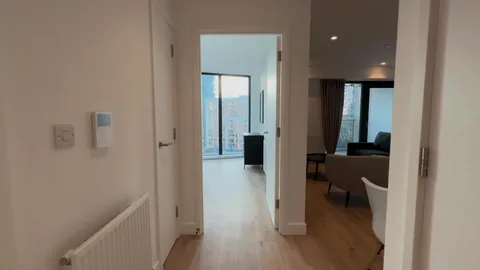

Usually not the full cost, and often nothing at all. In England, adjudicators treat ordinary scuffing over a tenancy as fair wear and tear, not damage. Where a deduction is fair, they reduce it for the paint’s age and the length of the tenancy (betterment), so a landlord cannot bill a tenant to make old paintwork brand new.
Can a landlord charge you for a full repaint because a wall is scuffed? Usually not, and often nothing at all. A widespread belief among landlords is that any marked or scuffed wall justifies charging the tenant for a full repaint. That is the wrong starting point. Deposit adjudicators in England begin from the opposite assumption: some scuffing is a normal result of living in a property, and paintwork wears out with time regardless of who lives there.
This post is general information, not legal advice for your specific dispute. It applies to assured shorthold tenancies in England, where deposits are protected in one of the three government-backed schemes.

What is the difference between fair wear and tear and damage?
Fair wear and tear is the gradual, reasonable deterioration you would expect from normal use over the length of a tenancy. Light scuff marks along a hallway, faint furniture rub near a skirting, small marks around light switches: these are the ordinary signs of someone living in a home. A landlord cannot charge a tenant for fair wear and tear.
Damage is different. It is deterioration beyond what normal use would cause. Deep gouges, crayon or pen across a wall, unauthorised repainting in a colour that was not agreed, holes from unfilled fixings, or a wall marked so heavily it needs full preparation and repainting rather than a touch-up. Damage can be charged for, subject to the rules below.
The line between the two is a matter of degree, age and tenancy length. There is no fixed rule that scuffs are always wear, or always chargeable. It depends on how bad the marks are, how old the paintwork was, and how long the tenant lived there.
Why can’t a landlord charge for a full repaint?
Because of betterment. Betterment is the principle that a landlord should not end up in a better position than they started, at the tenant’s expense. Paint has a finite lifespan. Decoration is generally treated as having a useful life of a few years before it would need refreshing anyway, whoever the tenant was.
So if a tenant scuffs a wall that was last painted some years ago, the landlord cannot recover the full cost of a fresh repaint. The paintwork was already partway through its life. A new coat leaves the landlord with better decoration than they had at check-in, and the tenant should not fund that improvement.
Both the Tenancy Deposit Scheme and the Deposit Protection Service apply this reasoning in their adjudication guidance. Where a deduction is justified at all, adjudicators typically apportion it: they reduce the claim to reflect the age of the decoration and the proportion of its useful life already used up. Often the result is a contribution towards redecoration rather than the whole bill.
How does the length of the tenancy change things?
A lot. The longer someone lives somewhere, the more ordinary scuffing you would expect, and the more the paintwork would have aged anyway.
Over a short tenancy in a freshly decorated property, marks stand out more, and the case for a deduction is stronger. Over a long tenancy, the same marks are far more likely to be treated as wear, and the paint would often be due for refreshing regardless. A five-year tenancy that ends with tired, lightly scuffed walls is usually a redecoration the landlord would have faced anyway.
What evidence actually decides these cases?
The check-in and check-out record, and proof of when the decoration was last done. Nothing carries more weight.
An inventory (a written and photographed record of the property’s condition and contents at the start of the tenancy) is not required by law. It is good practice, and it is the strongest evidence a landlord or tenant can bring to a dispute. It does not guarantee an outcome on its own. Where the check-in shows freshly painted walls and the check-out shows heavy marking, and there is a dated invoice for that decoration, an adjudicator has a clear picture to reason from. The adjudicator still weighs that evidence against wear, age and tenancy length. Without such records, a landlord claiming for a repaint often struggles, because they cannot show the walls were not already in that state.
The National Residential Landlords Association makes the same point in its guidance on redecoration costs: dated evidence of the decoration and clear before-and-after condition records are what justify a claim.
One thing that does not change the assessment is the level of rent. A higher-end or higher-rent property does not attract a stricter standard for scuffing. Fair wear and tear is judged by normal use and the age of the decoration, not by how much the tenant pays.
A worked example
A tenant rents a two-bedroom flat for two years. The living room was painted new at check-in, evidenced by a dated decorator’s invoice. At check-out, the check-out report shows moderate scuffing along one wall behind where a sofa stood, plus two darker marks near the door.
An adjudicator would reason roughly like this. The light rub behind the sofa is fair wear and tear over two years and is not chargeable. The two darker marks may be damage if they are beyond normal use. Suppose a repaint of that wall costs one hundred pounds. The paint was already two years into its useful life, and adjudicators commonly assume decoration lasts only a few years. So the landlord cannot recover the full hundred pounds, because that would deliver brand-new decoration in place of paint already well used. The adjudicator apportions: the tenant might contribute a modest share reflecting the remaining life of the paintwork and the extent of genuine damage, not the whole cost. The exact figure is a judgement, and the assumed paint life varies between cases and schemes, but the direction is consistent. The award is a contribution, not a full repaint.
Scenario table: likely adjudication outcomes
Scenario
How an adjudicator is likely to treat it
Freshly painted at check-in, short tenancy, and clear heavy marking at check-out
This presents the strongest case for a deduction. Betterment still applies, but because little of the paint’s useful life has been used, the landlord may be able to recover a larger proportion of the cost of a touch-up or repainting the affected wall.
Aged paintwork, long tenancy, and ordinary scuffing
This is usually treated as fair wear and tear. Little or no deduction is likely because the decoration may already be approaching or beyond its expected useful life.
Unauthorised colour change, crayon, pen, or deliberate marking
This is generally treated as damage rather than wear. A deduction for putting it right is likely, although the amount should still be apportioned to reflect the age and previous condition of the paintwork.
What should landlords and tenants do?
For landlords:
Keep dated proof of when you decorated, and make sure the check-in and check-out reports describe wall condition clearly with photographs. Do not assume a scuffed wall means a full repaint bill. Ask instead what a fair contribution is, given the paint’s age and how long the tenant stayed.
For tenants:
Light scuffing over a normal tenancy is generally wear, and you are entitled to say so. If a landlord claims for a full redecoration, you can point to betterment and ask for the deduction to be apportioned. Avoid the things that clearly count as damage: no unauthorised colours, no unfilled holes, no crayon within reach of small hands.
Worth watching next:
The deposit schemes periodically update their adjudication guidance and worked examples, and it is sensible to check the current TDS and DPS guidance before submitting or defending a claim. For a dispute involving real money, consider advice from a qualified adviser or your deposit scheme’s free adjudication service.
Sources:
- Tenancy Deposit Scheme: adjudication resources (fair wear and tear and betterment): tenancydepositscheme.com/resources
- Deposit Protection Service: adjudication guidance: depositprotection.com
- NRLA: what evidence do landlords need to justify redecoration costs: nrla.org.uk/news/…